New Negro Politics in the Jim Crow South by Claudrena Harold Bryant Simon Jane Dailey
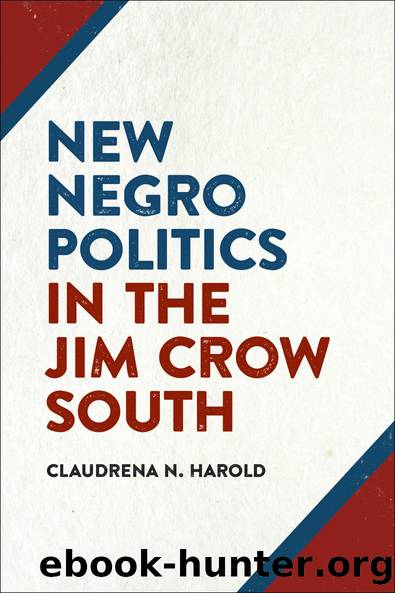
Author:Claudrena Harold, Bryant Simon, Jane Dailey [Claudrena Harold, Bryant Simon, Jane Dailey]
Language: eng
Format: epub
Tags: Nonfiction, Social & Cultural Studies, Political Science, Politics, Civil Rights, Social Science, Cultural Studies, African-American Studies, History, Americas, United States, 20th Century
ISBN: 9780820349848
Publisher: University of Georgia Press
Published: 2016-10-01T04:00:00+00:00
FIVE
The South Will Be Invaded
The same year that Marcus Garvey commenced his five-year sentence for mail fraud at the federal penitentiary in Atlanta, Abram Harris published a thought-provoking article in which he lamented the rising racial consciousness in black America. âConflicting race psychologies,â he argued, âvitiate any reapproachment between white and black workers and thus render impossible the unanimity of feeling and purpose necessary for independent working-class action in politics.â Harris challenged his forward-thinking peers to take the lead in curing the âblack massesâ of the âcolor psychosisâ that had developed as a result of their involvement in âreactionary organizationsâ such as Garveyâs Universal Negro Improvement Association (UNIA): âIf the Negroâs ever-increasing self-assertion is not guided by Negro intellectuals possessed of catholic vision, it will build within the present order a self-illuminating black world oblivious to things white.â1
Not everyone shared Harrisâs perspective. Far less concerned with the growing assertions of race pride emanating from African Americans, Thomas L. Dabney, a close friend of Harris during their undergraduate years at Virginia Union University, put forth a different reading of the political landscape. Opposed to the idea that the black masses required intellectual guidance from above, Dabney denounced what he viewed as myopic and often inadequately researched representations of African Americans as insufficiently class-conscious. A keen observer of U.S. labor relations, Dabney had witnessed firsthand the unwavering devotion of hundreds of black workers to trade union politics even when such devotion failed to translate into meaningful improvement in their material circumstances. âThat Negro workers are amenable to the philosophy of trade unionism,â he opined, âis attested by the fact that more than 200,000 Negroes belong to trade unions.â2 To deepen his readersâ understanding of this important dimension of black working-class activism, Dabney devoted a great deal of his intellectual work to examining African Americansâ complex relationship to organized labor. Of the many unions he examined in his writings, few intrigued him more than A. Philip Randolphâs Brotherhood of Sleeping Car Porters (BSCP). Organized in the summer of 1925, the Brotherhood focused on three important goals: improving the material conditions of porters and maids who worked for the Pullman Palace Company; gaining recognition as their representative body; and wiping out all vestiges of racial paternalism within and beyond the world of labor.3 Though media coverage of the Brotherhood focused primarily on its activities in New York and Chicago, the BSCP was no stranger to black southerners. As Dabney discovered during a 1928 research trip, âIn far Southern cities like Knoxville, Tennessee, Jacksonville, Florida, and Atlanta, Georgia, prominent Negroes and rank and file porters spoke in high terms of the Brotherhood and Mr. Randolph.â4 Unwilling to stand on the sidelines as various leaders and intellectuals debated the most effective strategies to improve African Americansâ economic condition, BSCP followers in the South embraced the unionâs political vision and its emphasis on the unionization of African American workers. In Norfolk, for example, Brotherhood members defended the BSCPâS unionization strategy as providing black Americans with âtheir only chance for economic emancipation.
Download
This site does not store any files on its server. We only index and link to content provided by other sites. Please contact the content providers to delete copyright contents if any and email us, we'll remove relevant links or contents immediately.
| Anthropology | Archaeology |
| Philosophy | Politics & Government |
| Social Sciences | Sociology |
| Women's Studies |
Cecilia; Or, Memoirs of an Heiress — Volume 1 by Fanny Burney(32636)
The Great Music City by Andrea Baker(32609)
Cecilia; Or, Memoirs of an Heiress — Volume 2 by Fanny Burney(32010)
Cecilia; Or, Memoirs of an Heiress — Volume 3 by Fanny Burney(31996)
We're Going to Need More Wine by Gabrielle Union(19108)
All the Missing Girls by Megan Miranda(16314)
Pimp by Iceberg Slim(14664)
For the Love of Europe by Rick Steves(14566)
Bombshells: Glamour Girls of a Lifetime by Sullivan Steve(14136)
Norse Mythology by Gaiman Neil(13457)
Talking to Strangers by Malcolm Gladwell(13439)
Fifty Shades Freed by E L James(13289)
Mindhunter: Inside the FBI's Elite Serial Crime Unit by John E. Douglas & Mark Olshaker(9419)
Crazy Rich Asians by Kevin Kwan(9345)
The Lost Art of Listening by Michael P. Nichols(7547)
Enlightenment Now: The Case for Reason, Science, Humanism, and Progress by Steven Pinker(7354)
The Four Agreements by Don Miguel Ruiz(6833)
Bad Blood by John Carreyrou(6669)
Weapons of Math Destruction by Cathy O'Neil(6362)
